The hits keep coming, folks. After Yuri is My Job!’s fifth volume concluded with the reveal of Mitsuki’s secret hopes for her Cafe Liebe persona, its sixth found Hime interrogating that secret, and perhaps uncovering more than she bargained for. Pursuing the ailing Mitsuki back to her own apartment, Hime demanded her old friend explain herself – and after a fair amount of prodding, cajoling, and negotiating, that is exactly what Mitsuki did.
She was ashamed of her honest thoughts, in truth, and afraid that revealing her ungenerous feelings would ruin things again. She wanted to be close to Hime, and disliked that Kanoko might share a similar closeness with her. She knew that wasn’t fair, but our honest feelings rarely are – underneath all the façades and niceties and Liebe-like performances, we are in truth often selfish creatures, rabid in our hungers and petty in our resentments. Mitsuki wanted to spare Hime from her ugliest feelings, but Hime’s demands made that impossible. And when it came down to either denying her friend or revealing her shame, she chose to put her faith in Hime’s kindness, and reveal her own lack of the same.
That alone might not have torn a rift between our leads; Hime certainly didn’t enjoy hearing Kanoko slandered, but was willing to admit she preferred an ugly truth to a nebulous denial. But as it turns out, Hime’s interpretation of Mitsuki’s dual personas wasn’t the only misunderstanding between them. Drawing Hime close just before their parting, Mitsuki sealed her desire for a renewed closeness with a kiss – a gesture which Hime seemingly responded to only once they returned to Cafe Liebe, by announcing her retirement from the salon.
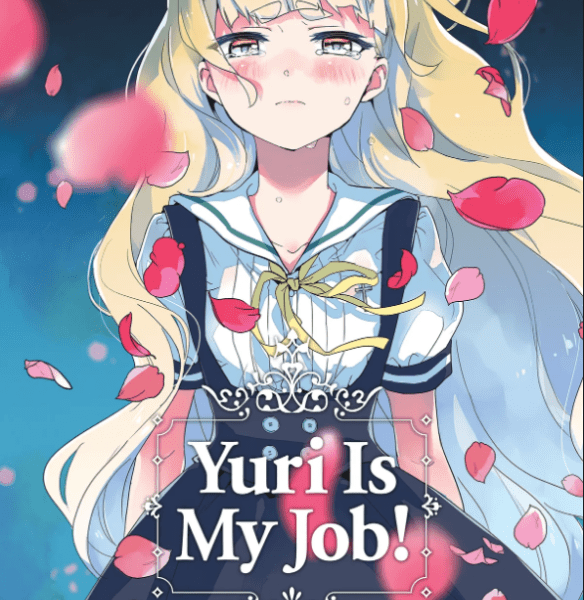
Thus we arrive at Yuri is My Job’s seventh volume, in the wake of Hime’s apparent rejection of Mitsuki’s feelings. The contrast of cover art and chapter start seems to emphasize the duality of our mercurial Hime; from a shower of private tears, she snaps back to looking bright and unbothered, announcing her retirement as casually as if she were discussing upcoming shift availability. In response, it’s actually Sumika who challenges her declaration, in an exchange laden with painful hidden intent.
For Sumika, this clearly calls to mind the cafe’s prior breakdown, when romantic entanglements threatened the wholesale closure of Cafe Liebe. After working so hard to first challenge and then support Kanoko’s feelings, Hime’s words feel like a bolt out of the blue, a flippant rejection of all the time they’ve spent getting to know each other. If Hime can quit so casually in response to so little apparent stimuli, then what were any of her efforts worth? Are the bonds they forge here truly so fragile or insignificant that they can be discarded so easily? Was Sumika entirely wrong about this place being special in the first place?
In response, Hime offers perhaps the most callous words she could conjure: “please think of it as though nothing I did in the salon ever happened.” Not just a rejection of her own presence in the salon, but a rejection of everything her coworkers invested in her – all the efforts they put into integrating her into their special world, and all the feelings they shared in the context of the salon. For Cafe Liebe’s true believers, this place is a sanctuary where lost souls are capable of genuine personal reinvention – but to Hime, all of that was apparently so insubstantial that she can freely announce “alright, I’m done playing pretend now” without a care in the world.
Mitsuki is the next to object, offering the more personal question of “what about our vow?” None of this was a performance for Mitsuki – to her, the establishment of herself and Hime as Schwestern was as real as any backstage declaration of loyalty and partnership. By rejecting the significance of that bond, Hime might as well be rejecting Mitsuki herself – and indeed, Hime makes that further rejection all the more explicit, by smiling as she offers the devastating “we can still be friends” consolation prize. Not lovers, not sisters, not anything special – just that same indiscriminate title of “friend,” the very label that both Kanoko and Mitsuki have so vehemently rejected.
The resulting void in our heroines’ lives is represented quite literally – a blunt, lonely square of exposition in a vast panel of darkness, a voice in the dark announcing Hime’s not here anymore. The ensuing pages do a wonderful job of visually conveying Kanoko and the others’ mental state. Panels are tall, plentiful, and lonely – Kanoko is nearly always trapped alone in the frame, or observing a Hime she cannot touch. Even in the rare panels characters share, they are still divided – after three isolating setup shots at Liebe, the one panel containing both Kanoko and Sumika sees them stretched towards opposite ends, with the word balloons of Kanoko’s polite, noncommittal greeting actually serving to push Sumika all the further away.
And then there is Mitsuki. Standing alone and unreachable, the hubbub of the cafe that she used to delight in now represented as a sequence of panels sliding away from her lonely vigil. The pattern is repeated, enforced; Mai handles the bustle while Mitsuki stands aside, isolated by paneling and abandoned by her own voice, now simply going through the motions as Kanoko quietly observes. One lost at sea, the other actively rejecting companionship, fending off Sumika’s entreaties with hostile posture, panel borders, and aggressively conclusive word balloons.
Misunderstandings, missed connections, empty panels and lonely halls; the contours of Kanoko’s increasingly isolated world remain vividly clear as she attempts to suss out her friend’s true feelings, until we hit a dramatic visual breaking point. Employing the light coming from outside the school as a blinding omen, Miman presents Kanoko as literally unable to recognize her friend anymore, so uncertain she is of Hime’s true feelings. Thus Kanoko challenges her once more, and receives a brief glimpse of the real Hime, the Hime we saw sobbing on the volume’s cover. Hime is clearly feeling just as isolated as the rest of them – thus, with Kanoko’s mission now established, the rescue operation can begin.
Our accomplices do their best to look imposing as hell as they set to work, with Sumika calling Mitsuki aside for a private meeting. With the monitor turned off and the cafe clear, Kanoko then at last confronts her nemesis, the two momentarily united by their shared desire for Hime’s return. Unfortunately, as with the divide between Hime and Mitsuki, mutual understanding doesn’t necessarily imply mutual agreement. After revealing the truth of her actions to Kanoko, Mitsuki is simply reassigned to another standard Kanoko category of “Hime enemies” – those who confess their obviously one-sided crushes to Hime, thereby burdening her with the responsibility of responding to their feelings. For characters so assigned, being previously close to Hime actually makes their actions all the worse, because it means Hime must both reject a confession and reassess the fundamental nature of their prior relationship.
It’s a delightfully messy stew of incompatible desires, all built on the clear, coherent differences in Mitsuki and Kanoko’s perspectives. Mitsuki is operating off the basis of Hime’s prior strong-arming, wondering how things could have gone wrong when she did everything Hime desired. Worse, she was actually the one unwilling to share her feelings, desperate to avoid precisely this outcome – so was the best possible choice then to lie to Hime against Hime’s own wishes, and thereby sacrifice her own potential happiness for fear that her unspoken desires might upset her friend?
Of course, Kanoko isn’t thinking about either Mitsuki’s feelings towards Hime, or Hime’s desire for clarity in her relationship with Mitsuki. For her, this is simply the latest installment in a long line of people who impress their own feelings on Hime, projecting unintentional implications on Hime’s generous, accommodating façade, and therefore making a mess for the real Hime that only she knows to clean up. Raging against Mitsuki’s audacity, it seems like Kanoko is fighting not just for Hime’s sake, but for her own special status as the one person able to honestly communicate with her. Hime’s rejection of all suitors was practically a symbol of their special trust. Kanoko’s bitterness at Mitsuki invading her territory bubbles to the surface when Mitsuki outright admits that she envied the easy trust they share – but as their paired gifts reflect, neither of them are quite the “one and only” that they wish themselves to be.
The confrontation verges on physical violence as Kanoko is forced to reconsider what Hime’s gift actually meant, if it even meant anything at all. What was once a precious demonstration of Hime’s special favor has now been proven to be a carelessly offered trinket, another lie from the façade. Thus Kanoko tries to actually throw the barrette at Mitsuki; wounded by Hime, she attempts to wound Mitsuki with the same instrument, and thereby reject the idea that Mitsuki could ever share an equal place in Hime’s heart.
Unsurprisingly, Mitsuki doesn’t really blame Kanoko for her outburst, and is even swift to acknowledge her adversary’s reasoning. After all, Kanoko is only saying what Mitsuki herself has long internalized – that her feelings are a burden to others, that she is fundamentally incapable of being a considerate friend, and that her understanding of a situation is always fragmentary and one-sided. Everything both Kanoko and Hime have done in the wake of her confession has only affirmed she was right to shun honesty, and wrong to believe Hime could ever feel the same way about her.
But even if Mitsuki doesn’t believe in her own emotional growth, the material consequences of her progress at Liebe mean she still has friends in her corner. As Mitsuki laments her inability to meaningfully connect with Hime, she is offered a sounding board by the classmates she was able to befriend back in volume five, when she first applied the social lessons of Cabe Liebe to her own life. Self-improvement is never a straight line; it is easy to backslide or take wandering roads towards personal development, and just as easy to doubt even meaningful personal progress. It is thus all the more fortunate that Mitsuki has already made strides that cannot be banished by self-doubt, like her acquisition of a friend who’s begrudgingly willing to admit that yeah, sometimes our feelings will impose on others, and that’s not a crime.
It’s an interesting variation on the lessons Mitsuki’s been provided so far. Hime has mostly expressed her desire for intimacy with Mitsuki in terms like “I would never judge you for your feelings” or “I’m sure it’s just a misunderstanding,” framings that assume Mitsuki’s issues are solely to do with communication, rather than the actual substance of her emotions. But this is something different – an acknowledgment that Mitsuki’s feelings will sometimes be a problem for others, and that’s still okay. We cannot just hollow ourselves out in service to the perpetual comfort of those around us; sometimes we must stand our ground, and acknowledge that our truth puts us at odds with the feelings of others. Too much of that certainty obviously leads to inflated self-regard and dismissal of others’ perspectives, but too little is just as tragic, even if the only one suffering is oneself.
Thus Mitsuki at last finds a way to grapple with Kanoko on equal ground – not by denying either Kanoko’s feelings or her own, but by seizing on what they clearly share, their mutual desire to understand Hime. By asserting herself without denying Kanoko’s truth, she is able to at last build a bridge with her presumed enemy, and bypass Kanoko’s ever-present defensive posture. In a volume largely defined by visual separations, Mitsuki’s new tactic for approaching Kanoko (and thereby better understanding Hime) sees them at last sharing the frame.
After all the acrimony of their preceding encounters, alongside the persistent sense of isolation evoked by Miman’s banishing of Hime from the frame, it is an incredible relief to see Mitsuki at last honestly communicating with Kanoko, and admitting to the things she either fears or envies. And with her own guard thus lowered, Kanoko is at last able to speak honestly in return – not necessarily as a friend, but as someone equally invested in Hime’s happiness. Kanoko will probably never genuinely like Mitsuki’s personality, given she’s so certain that Mitsuki’s bluntness is an actively hostile instinct, but she can at least concede that sometimes, bluntness is exactly what a situation calls for.
Then at last, in a volume heretofore defined by her conspicuous absence, we finally jump to Hime’s own perspective. Ultimately, the source of her discomfort and self-distancing isn’t particularly mysterious; Hime had become accustomed to maintaining a specific distance from the feelings of others, and having that distance so dramatically diminished has left her feeling unmoored. What’s more, the actual source of that discomfort has come from one of the few people she felt comfortable sharing her “true” feelings with, meaning even her usual coping mechanisms have been stolen from her. With no one to help her process Mitsuki’s disruption of her boundaries, she has unsurprisingly retreated into her façade, no longer certain of her footing beyond the range of her precious performance.
In Hime’s mind, it must feel like Mitsuki has essentially jumped between two scripts, transitioning herself from the role of confidant to the role of romantic suitor. Of course, Hime’s attitude towards her suitors is largely designed to lessen the blow of knowing she’s hurting someone’s feelings – thus she has adapted a defensive, almost resentful attitude towards such people, making it easier to to feel like she’s not “in the wrong” in some ill-defined way by rejecting their undesired feelings. But how can that method of reducing her culpability in assuaging the hurt feelings of others (a responsibility that indeed should not fall on her) help when she actually wants to get closer to Mitsuki, if only in a different manner from the relationship Mitsuki has proposed?
What’s more, it’s apparently not just Mitsuki at this point. When approached by Kanoko regarding her final Cafe Liebe appearance, she finds that even her original confidant has now had enough of her evasions, and no longer trusts her to show up to the salon. There’s a sad symmetry between Hime and Mitsuki’s positions – both of them took what they believed to be the absolute safest route in repairing their friendship, and yet both have somehow found themselves punished for believing in their friend. Were they wrong to seek honesty in the first place? Would both of them have been better off simply maintaining their barricades?
Reflecting back on the day of the confession, we now see Hime’s reaction to Mitsuki’s kiss in visceral, almost tangibly tactile form. A full-page low-angle portrait of Hime presents her feelings as sinking like a pit in her stomach, her raw “what is this?” presented as a stone in her gut. And on the following page, her shaking hands offer a portrait of anxious fragility, bolstered by the variation of design in her thought balloons – rising in wobbling, uncertain shapes, they appear like bubbles drifting up from uncertain depths, fragmentary emotions experienced as Hime sinks underwater.
Order is restored only after she returns home, with the sturdy, right-angled panels of the night sky and familiar apartment acting like barricades protecting our discombobulated princess. But external walls can do little to defend against the erosion of her treasured memories. With this new information slotting into place, Hime is forced to reassess all her prior interactions with Mitsuki, wondering what was simply a gesture of friendship, and what was actually seeking a closeness she could not reciprocate. Romance within an established social group can be messy business, and it’s very much to Miman’s credit that Hime’s sense of displacement upon receiving an unwanted confession is treated with just as much sympathy as Mitsuki’s romantic feelings.
As Hime’s recollections take us onward to that last, fateful day at the salon, we see how agonizing that day was from her perspective. In the impossible situation of having allegedly reciprocated Mitsuki’s affection, Hime even considers adjusting her façade to include a false romance, gritting her teeth and offering the tragic “I could totally act like her girlfriend, if I put my mind to it.” But play-acting civility with classmates she already keeps at arm’s length is one thing – attempting to put on a performance of romantic love with someone she genuinely does care about is quite another, an act of mental partitioning as laborious as it is painful. Thus she is left with the same fundamental task – in order to stay true to her own feelings, she must necessarily reject her dear friend.
Their final confrontation is not a cathartic, validating exchange of emotions. They are too close in their friendship and too distant in their desires for anything like that; sometimes our feelings are incompatible with the feelings of the ones we love, and acrimony or sorrow inevitably result. Each of their perspectives are reasonable, and each of their methods of mitigating misunderstanding are in full effect – Hime attempts to paper over their disagreement with cheerful irreverence, while Mitsuki demands honest communication, unwilling to again be slotted among the “enemies” that earn Hime’s false smiles. Hime responds with a series of escalating warnings, but Mitsuki is undeterred – without an honest answer, she simply cannot move on.
So Hime is forced to undeniably reject Mitsuki, only for the fallout to spark a new fire, as Hime confesses she still can’t possibly continue at Cafe Liebe. How could she, knowing how her presence affects Mitsuki, and how Mitsuki’s gestures of honest love reflect on her in turn? To this Mitsuki offers the hopeless “I’ll banish my feelings right away,” a promise she couldn’t possibly keep. But how could it all come to this, anyway? How could seeking nothing but honesty and intimacy lead to such a bitter parting? Was Mitsuki wrong to reveal her true feelings, or Hime wrong to seek them? What possible lesson can be gleaned from such a tragic result?
Unfortunately, our secret hearts have no obligation to line up in efficient, agreeable order, locking in perfect sequence with the hearts of those we love. We are messy, angular, frequently incompatible organisms, each burdened with a thousand desires that we can only hope might find validation in a chaotic, uncaring world. There is no certainty that a shared desire will achieve a happy result, and no love so undeniable it will inevitably be treasured by its recipient. Love is not a happy ending; it is a promise, a practice, a vow we share. And a love measured in tears is still a precious love indeed.
This article was made possible by reader support. Thank you all for all that you do.